

2+ items ship free in the US · 4+ items get 15% off
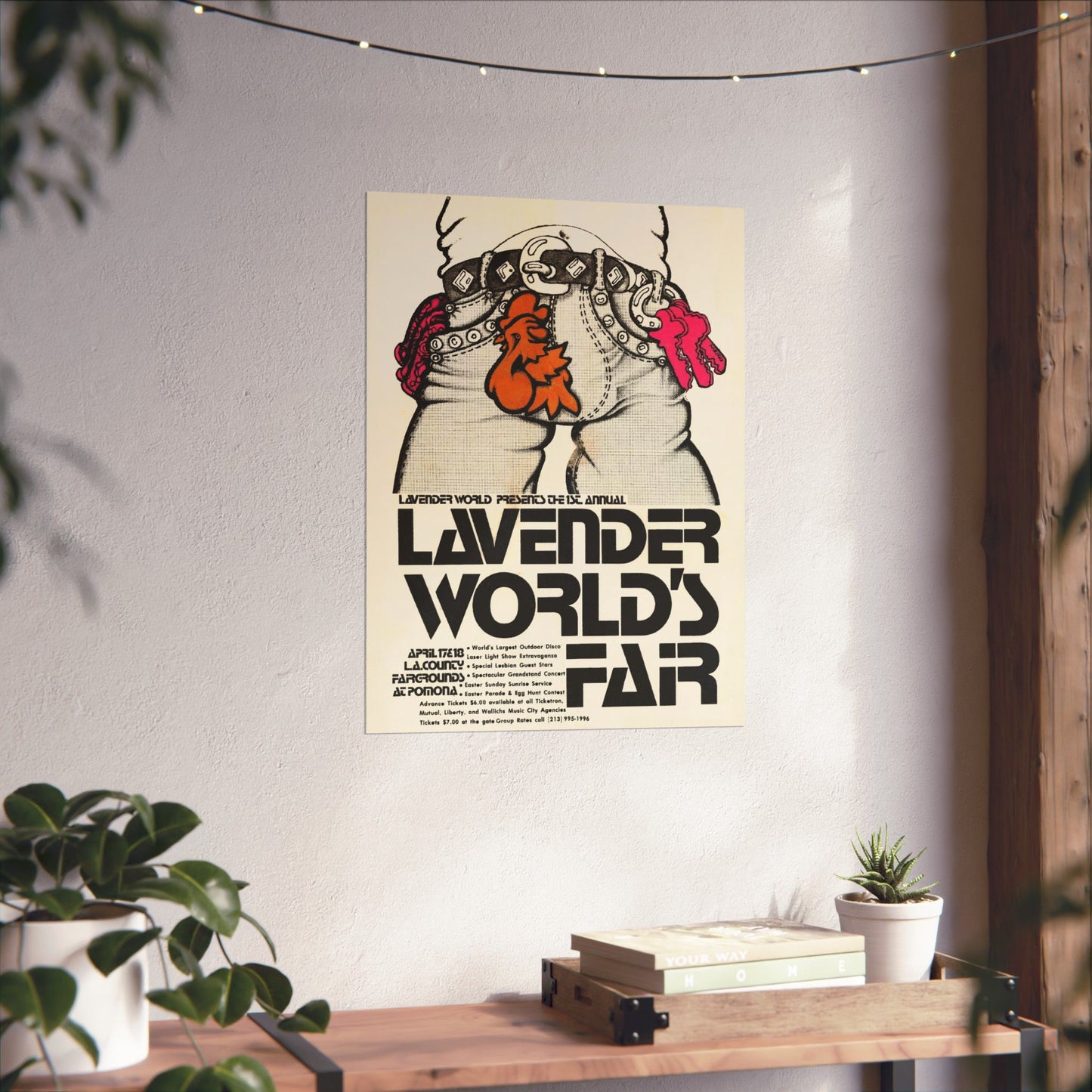
Lavender World's Fair Poster (Reprint of 1976 "Gay Woodstock" Poster/Los Angeles)
Lavender World's Fair Poster (Reprint of 1976 "Gay Woodstock" Poster/Los Angeles)
2+ items ship free in the US · 4+ items get 15% off
Couldn't load pickup availability
Lavender World’s Fair — Los Angeles County Fairgrounds (1976)
The “Gay Woodstock” That Wasn’t.
In 1976, promoters attempted something audacious: a massive, multi-day LGBTQ festival at the Los Angeles County Fairgrounds — marketed first as the “Gay World’s Fair” before copyright concerns forced a rebrand to the Lavender World’s Fair.
The ambition was enormous.
A “world’s largest outdoor disco.”
Major musical headliners.
National media attention.
Thousands of attendees.
Advertisements promised performances by the Pointer Sisters, Iron Butterfly, and radio personality Wolfman Jack. It was pitched as a landmark moment — a West Coast answer to Woodstock, but for the gay community at a time when public LGBTQ mass gatherings were still rare and politically charged.
But the execution collapsed.
Organizers failed to pay performers. Headliners canceled. Funding evaporated. The promised production scale never materialized. Attendance estimates for opening day varied widely, but by the second day, numbers dwindled dramatically. A heavily promoted sunrise Easter-style service was canceled.
Frustration boiled over.
Ticket-holders who paid premium prices for a historic event found themselves facing empty stages and broken promises. Protests erupted. Confusion spread. What was meant to be a celebratory breakthrough became a cautionary tale in queer event organizing.
The fair also faced external opposition, including anti-gay protest activity led by local religious groups — adding another layer of tension to an already unstable situation.
Yet even in failure, the Lavender World’s Fair remains historically significant.
It reflected a moment in the mid-1970s when queer organizers were testing scale — imagining that LGBTQ visibility could fill fairgrounds, not just bars and community centers. It was a bold, messy, early attempt at mass public queer celebration long before corporate Pride festivals became normalized.
Share